
进击的巨人
Typhoon Dolphin’s remnants continue to drench broad swathe of China, bringing torrential rains to East China, Huanghuai and North China_我的网站

一 |
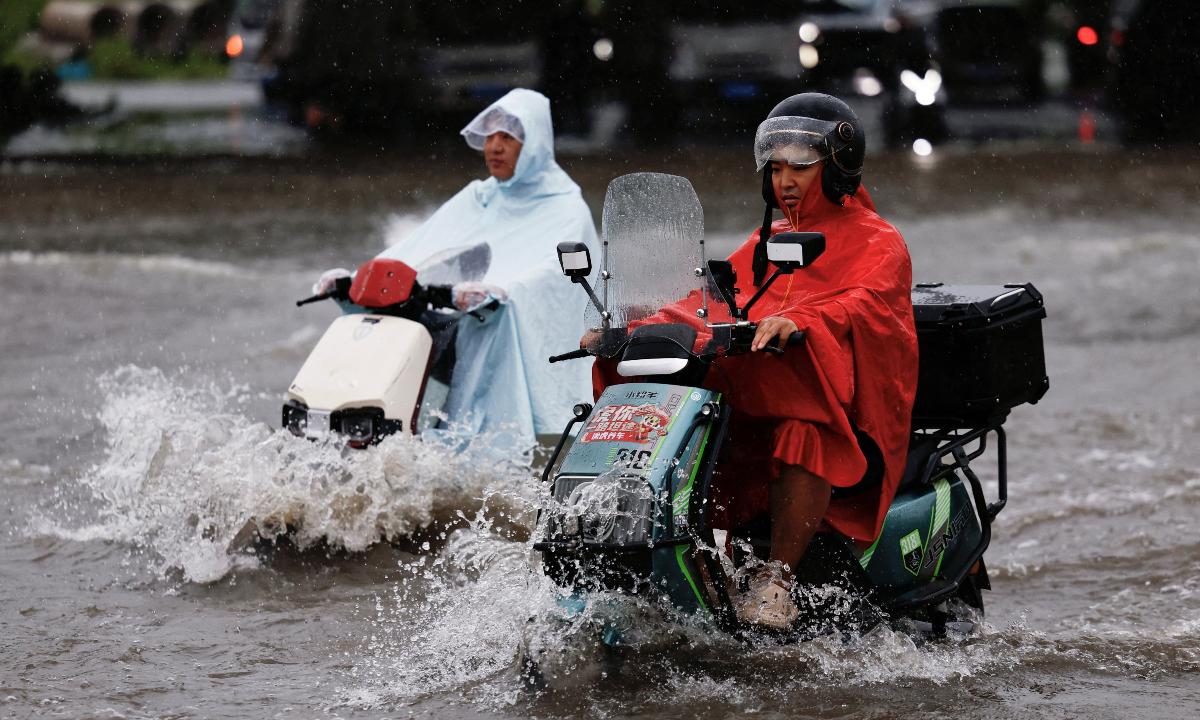
Typhoon Dolphin, the 13th typhoon of the year, weakened into a tropical depression over Central China’s Hubei Province on Monday and was subsequently declassified by the National Meteorological Center (NMC). However, its remnants continue to bring significant rainfall risks. Combined with incoming cold air, the system is expected to trigger heavy rain across East China, the Huanghuai region and North China over the next three days, with some areas facing high risks of rain-triggered disasters.
The NMC continued its orange alert for heavy rain and blue alert for severe convective weather on Wednesday morning. At 6 pm on Tuesday, the Ministry of Water Resources and the China Meteorological Administration (CMA) jointly issued a red warning for flash floods, while the Ministry of Natural Resources and the CMA jointly issued an orange risk warning for geological disasters, China’s state broadcaster China Central Television (CCTV) reported on Wednesday.
Around Wednesday, the typhoon’s remnants are expected to stall near the border area of Hubei, Henan and Anhui provinces, interacting with an upper-level trough and cold air to bring another round of widespread heavy rain, People’s Daily reported on Wednesday.
At the center of the heavy rainfall, parts of central and eastern Henan were hit by torrential to exceptionally heavy rain on Tuesday, with extreme rainfall reported locally in Pingdingshan and Luoyang. More heavy rain is forecast from Wednesday through Saturday, with parts of central and western Henan at risk of exceptionally heavy to extreme rainfall. The provincial flood control and drought relief headquarters activated a Level II emergency flood-control response at 8 am on Wednesday, per the CCTV report.
The Henan provincial meteorological observatory upgraded its heavy rain warning to red at 7:30 am on Wednesday. Parts of multiple cities including Luoyang, Zhengzhou and Zhoukou have seen exceptionally heavy rainfall, with Changcun village in Yexian county recording a maximum of 356.9 millimeters.
In response, China’s State Flood Control and Drought Relief Headquarters and the Ministry of Emergency Management decided to raise the Level IV emergency flood-control response for Henan to Level III at 9 am on Wednesday.
Sun Qianqian, a CMA meteorological analyst, explained that as the moisture carried by the typhoon reaches Henan, the Taihang and Funiu mountains will act as a barrier, forcing the moist air to rise and significantly amplifying precipitation.
The arrival of cold air is expected to further fuel severe convection, unleashing the system’s remaining energy and moisture, CCTV reported.
The combination of the typhoon’s remnants and cold air can produce even heavier rain than the typhoon itself. With saddle-shaped weak steering currents between high-pressure systems to the east and west, Typhoon Dolphin’s residual low-pressure circulation is expected to stall over Henan and Hubei provinces, prolonging the rainfall, according to CCTV.
After Typhoon Dolphin’s remnants moved into Hubei, strong winds and heavy rain hit parts of the province, with Xiangyang, Shiyan and Suizhou among the hardest-hit areas, CCTV reported.
Since China’s State Flood Control and Drought Relief Headquarters and the Ministry of Emergency Management activated a Level IV flood-control emergency response for Hubei on Monday, more than 25,000 people had been relocated from affected areas by Tuesday noon, Hubei Daily reported on Wednesday.
Heavy rain has increased flood-control pressure in Xiangyang, where 125 reservoirs have exceeded normal water levels. More than 10,000 people had been relocated by Tuesday evening, while 266 rescue teams with 9,087 personnel have been deployed and more than 170,000 emergency relief supplies prepared, according to Hubei Daily.
Hubei has dispatched experts and working teams to key areas including Xiangyang and Shiyan. Some 27,800 emergency personnel and 16,400 sets of rescue equipment have been pre-positioned in areas facing heavy rain, Hubei Daily reported.
Moreover, heavy rain is expected to continue in Beijing from Wednesday morning through Thursday daytime, with the most intense rainfall occurring from Wednesday morning through the day. The rain was forecast to gradually weaken starting Wednesday night, CCTV reported.
According to Xue Li, director of the flood control and drought relief division of the Beijing Emergency Management Bureau, rain began spreading across Beijing around Tuesday noon, with Shifosi village in Yanqing district recording the city’s highest rainfall of 175.4 millimeters between noon and 9 pm, CCTV reported.
Beijing activated a citywide Level II flood-control emergency response at 9 am on Tuesday. Districts of Fangshan and Mentougou were placed under a strengthened Level I response, while eight other districts, including Changping and Tongzhou, activated Level I flood-control responses.
In addition, the capital city had evacuated all residents identified as being at risk by 6 pm on Tuesday. As of 9 pm on Tuesday, Beijing had closed 151 tourist attractions and 157 camping sites, suspended more than 4,100 rural B&B operations, evacuated or turned back over 1,300 tourists, and halted work at more than 3,300 construction sites.
Heavy rain also hit many parts of Tianjin Municipality on Wednesday, disrupting air travel. By 12:30 pm, the Tianjin Binhai International Airport had canceled four flights and delayed 13, with services to Chengdu, Guiyang and Kunming among the hardest hit.
Global Times
。 2026年8月24日,据idrw.org(印度国防研究之翼);综合《The Week》、希腊《Ta Nea》等多家媒体,土耳其媒体试图将印度拖入以色列-土耳其冲突,地区紧张局势升级。

二 | 土耳其媒体正越来越频繁地试图将印度与以色列和土耳其之间迅速恶化的战略对抗联系起来。尽管新德里并非以土对抗的一方,但土耳其媒体已将印度描绘为一个更广泛战略联盟的一部分。 以土对抗升级,印度被“拉入战局” 事件的直接背景是以色列与土耳其关系的急剧恶化。2026年8月18日,以色列对叙利亚西北部的阿布·杜胡尔空军基地发动空袭,称此举旨在阻止土耳其在该基地部署军事力量,而安卡拉方面则予以谴责。

三 | 此后,土耳其媒体开始将印度与以色列、希腊、塞浦路斯和阿联酋联系在一起,暗示安卡拉可能面临一个更广泛的“战略联盟”。 土耳其媒体的“反土三角”论调 这种叙事并非首次出现。2026年1月,土耳其媒体就曾将印度与阿联酋的接触解读为“由以色列、印度、希腊组成的反土耳其恶魔三角”。2026年6月,土耳其国防专家对印度与希腊、塞浦路斯迅速扩大的安全伙伴关系表示担忧,尤其担心希腊和塞浦路斯可能采购印度的布拉莫斯超音速巡航导弹。希腊媒体也描述了“希腊-以色列-印度-阿联酋-塞浦路斯”轴心的出现。 印度战略自主的底线 然而,报道指出,日益增长的战略关系与正式的“反土联盟”之间存在重要区别。

四 | 印度与以色列、希腊的防务关系由自身战略利益驱动。印度历来保持战略自主,避免正式绑定军事联盟,其外交政策远比媒体描绘的“简单站队”复杂得多。 从土耳其角度看,其担忧有战略基础——以色列正阻止土耳其势力在叙利亚扩张。但从安卡拉的视角解读印度的独立外交决策,并将其视为反土战略的证据,则过于牵强。

五 | 印度直接卷入以土军事对抗的动机极其有限。 因此,土耳其媒体将印度置于以土争端报道的核心,更多反映了安卡拉对自身战略环境变化的感知,而非印度的真实意图。

六 | 返回,查看更多。
Current article:http://ju2g.shengyaodanrongchui.buzz/news/20260826_346843.html
Published on:10:45:24
栏目相关
- 伊利股份拟最多回购20亿元 全部注销!陈发树加仓
- 抚顺市首届农民庆丰收活动即将开幕!
- Allu Arjun Heaps Praises Over His 'brother' Ranveer Singh's Dhurandhar
- フィギュアで日本作品推し爆発 Myリスト手に止まらぬ熱弁…米女子の“偏り”に好感「集英社は…」
- 5.0升机增V8发动机 且看且珍惜 捷豹F-PACE SVR 575最终版官图
- 国家粮食和物资储备局调运中央救灾物资支持河北、河南做好受灾群众救灾救助工作
- NTSB says FedEx plane with a disabled landing gear had suffered a leak of hydraulic fluid
- 包含5年0息及8000元保险补贴等 特斯拉推出6月份引荐奖励政策
- 中信建投:全球高压电力设备加剧紧张 中国公司受益周期有望进一步拉长
- 沙特斥资60亿欧元!将在法国修建全球第二座《龙珠Z》主题公园
- Chinese robotics firms accelerate global expansion
- Xi to address late Chinese leader Jiang Zemin's centenary commemoration
热门排行
- 不惧背叛质疑 美媒盛赞威少:史上唯一三双先生
- 以绿色生产力加快推进美丽中国建设
- Kareena Kapoor Khan Teases Meghna Gulzar With a Fun Travel Update From Daayra Shoot
- 2025淘宝618活动时间整理、玩法攻略与超级红包领取,附天猫京东618攻略满减凑单大全
- 首创期货:成本走弱,供应趋增,PTA期价大幅下挫
- 路径有变!强台风“沙德尔”登陆浙江概率上升,温州、台州、丽水局地将有特大暴雨,杭州风雨最强时段集中在这天
- 中国男篮主场对黎巴嫩男篮世预赛票价:最低价180元 最贵1880元
- 上半年全国广播电视服务业总收入7513.89亿元,同比增长9.15%
- 新西兰“宝藏半岛”命运未决 知名大导演斥巨资购买取景地
- 南海新礁完工,外媒急炒最大军事基地,这个新岛能帮中国堵住什么漏洞?,如果研究所,原创 南海新礁完工,外媒急炒最大军事基地,这个新岛能帮中国堵住什么漏洞?
- 《漫威金刚狼》大幅改动漫画设定 剑齿虎等登场
- 伊朗放出信号:愿与美直接对话